3 May 2026
Fifth Sunday of Easter (Year A)
Jn 14:1–12
The words we hear today (Jn 14:1–12) come immediately after chapter thirteen of the Gospel of John, where Jesus put aside His garments and washed the feet of his disciples. But it is also the chapter where Jesus spoke plainly of His Passion, drawing near (Jn 13:33), where Judas’ betrayal was spoken off and carried out (Jn 13:30), and where Jesus foretold Peter’s denial (Jn 13:38).
This is the dramatic context in which Jesus speaks the words recorded by the evangelist John in chapters 14–17; these are words of care, words of life with which the Lord desires gives His disciples to accompany them through the trial that is about to unfold.
And these words begin like this: “Do not let your hearts be troubled” (Jn 14:1).
It is a phrase that Jesus, throughout His earthly ministry, repeated often, in conversation with His disciples or with the people he encountered, whenever death seemed to prevail, during the storm on the lake, or when illness was about to take a loved one away. Do not be afraid, do not fear anything. These words resound here too, at this moment when fear threatens to darken the disciples’ lives and faith.
There are two reasons why this might happen.
The first is the imminent Passion of Christ, which seems to signal the possible end of the relationship between the Lord Jesus and His disciples. Jesus himself says it clearly: “I will be with you only a little while longer” (Jn 13:33).
But another fear arises in the disciples’ hearts, caused by their own unfaithfulness, by their own limited ability to love, by their divided hearts. It is the fear not so much of what is about to happen, but of being unable to resist the temptation to flee; it is the fear of themselves. But Jesus does not accuse them, reproach them, threaten them, or make them feel guilty.
But Jesus does not merely comfort them or sugar-coat the truth: he does not tell them to rest assured that they will never again make mistakes, run away or betray him. He knows that his disciples can overcome this fear and get through this difficult time without having to make an extra effort or resolve to do better. They cannot do it on their own.
Jesus gives several reasons why they can prevent fear from overwhelming them.
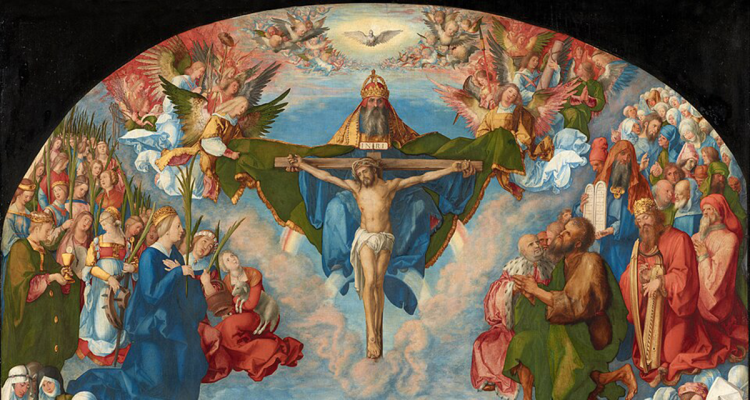
Let us focus on the first, where Jesus says that there is a home awaiting us, the Father’s house (In my Father’s house there are many dwelling places – Jn 14:2).
Jesus speaks of it as a large and spacious house, where there is room for everyone and where, above all, a place has been prepared by Jesus himself through his becoming man, and through his return to the Father bearing our redeemed humanity.
Jesus does not simply say that the Father’s house is large and spacious, but emphasises that this house has many dwelling places. The term Jesus uses recalls a verb very close to John: ‘to remain’. The dwellings of which Jesus speaks of are not rooms, but places of abiding, where a lasting relationship happens. It is not an architectural image, but a Trinitarian one: the Father’s house is communion itself with God.
And the fact that these dwellings are many does not mean separate rooms, but different ways of sharing in the same communion, in the same house. There is not only one correct way to be a disciple, and there is room even for the one who has betrayed, for the one who has denied.
Later on, Jesus takes this further and says: “Whoever loves me will keep my word, and my Father will love him, and we will come to him and make our dwelling with him” (Jn 14:23).
The Father’s house, therefore, has as many dwellings as there are human lives. It is not the place where we go, but the place where He comes. These many dwelling places are not rooms in heaven to be earned through our good works, but the many, infinite ways in which God dwells within humanity and in which humanity dwells within God.
Jesus, then, is not speaking to describe heaven, but to allay the disciples’ fear that what is happening might sever their relationship with Him and with the Father. Not only will it not sever that relationship, but, on the contrary, precisely the Passover of Jesus will turn this house into an abode, a stable and secure place.
And this will be the “greater thing” (Jn 14:12) that the disciples will be able to do beginning from Easter: to believe in this house of many dwellings, to believe firmly that our life has a dwelling place: “whoever believes in me will do the works that I do,
and will do greater ones than th ese, because I am going to the Father.”
And it is “greater” not because it is more spectacular, but because it is the work that transforms the heart, that changes the way we live in the world, that frees us from fear.
+Pierbattista
*Translated from Italian