Thursday, May 14, 2026
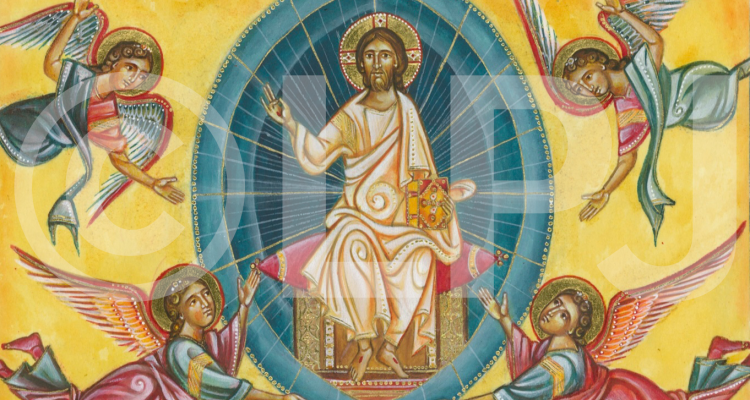
Ascension of the Lord, A
In these words that the Risen Lord speaks as He takes leave of His disciples and returns to the Father, there is a small conjunction that carries a strategic meaning.
We are at the final verses of the last chapter of Matthew’s Gospel, and Jesus says: “All authority in heaven and on earth has been given to me. Go, therefore, and make disciples…" (Mt 28:18–19). The conjunction, ‘therefore’, indicates, a consequence: something new has happened, so a new effect follows from it.
What has happened?
Jesus rereads the events of Easter as the moment when all authority was given to Him, in heaven and on earth.
First we note that this authority was given to Him: the Risen One does not proclaim Himself Lord, but it is the Father who constitutes Him Kyrios, Lord of history and of the cosmos. It is an authority born from relationship, not from personal conquest.
It is also an Easter authority: not the authority of the kingdoms of this world (cf. Mt 20:25), but the authority of the One who conquered death by giving life; and for this reason, His authority bears the definitive character of self-giving love.
Ultimately, it is an authority that unites heaven and earth, meaning, there is no longer anything out of His reach; therefore, no distance, no darkness, no periphery is excluded from His presence.
The authority of the Risen One is the sovereignty of love that has passed through death and can now reach every creature.
This sovereignty is evident in the passage through a term that, in the original language, appears four times: the word “all”: “All authority in heaven and on earth has been given to me” (Mt 28:18), “Go and make disciples of all nations” (Mt 28:19), “all that I have commanded you” (Mt 28:20), “I am with you always” (Mt 28:20).
This fourfold repetition does not describe a power that dominates, but a power that fills: it is the fullness of the Paschal life that now embraces the cosmos, reaches every people, illuminates every word of Jesus, and accompanies every day of history.
The “all” of the Risen One is life brought to its fullness: a sovereignty that does not oppress but generates life; does not exclude but embraces; does not restrict, but expands.
It is at this point that the “therefore” we mentioned at the beginning comes into play.
Since the Risen One’s lordship is universal, and since His gift of love is for everyone, therefore the disciples can set out and bring the gift of this new beginning to all.
Their mission springs from fullness: the disciples do not wield power, but share in a life that now overflows and spreads to all peoples.
It is therefore important to emphasize this: the missionary mandate (“Go therefore…”) is not a human task, but an action that takes place within Christ’s eschatological sovereignty.
In other words, the disciples do not go “before” Jesus reigns, but they can go because Jesus already reigns; they do not prepare the Kingdom, but they act within the Kingdom inaugurated by Easter.
If the Kingdom has already been inaugurated by the Risen One, then our mission is to make it known, to bear witness to it, and to make it accessible. Matthew expresses this with three verbs: to make disciples, to baptize, and to teach (Mt 28:19).
“Making disciples” is the main verb of the sentence. It does not mean “converting” or “persuading,” but rather introducing someone to a journey. A disciple is one who enters into a relationship with the Master, not one who adheres to a system. Making disciples, therefore, does not create the Kingdom; it opens the way to the life that the Risen One already offers.
Missionaries must also “baptize,” which does not simply mean performing rituals, but continually immersing everyone in the communion of the Trinity, keeping open the access to the flow of love that unites the Father, the Son, and the Holy Spirit. It is access to the very heart of the Kingdom, for the Kingdom is the life of the Trinity that the Risen One has opened up for us.
And finally, Matthew speaks of “teaching”: this is not abstract doctrinal instruction, but teaching how to keep (“observe”) all that Jesus commanded. It is a teaching that shapes one’s life, not just one’s mind. To teach means to help people live according to the logic of the Risen One.
A life that springs from the fullness of the Risen One, to whom all authority has been given, through whom all nations are reached, for whom his entire Gospel becomes a way of life, and whose presence fills every day.
+Pierbattista
*Translated from the original in Italian