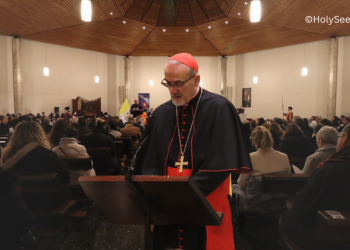
Homily for the Chrism Mass
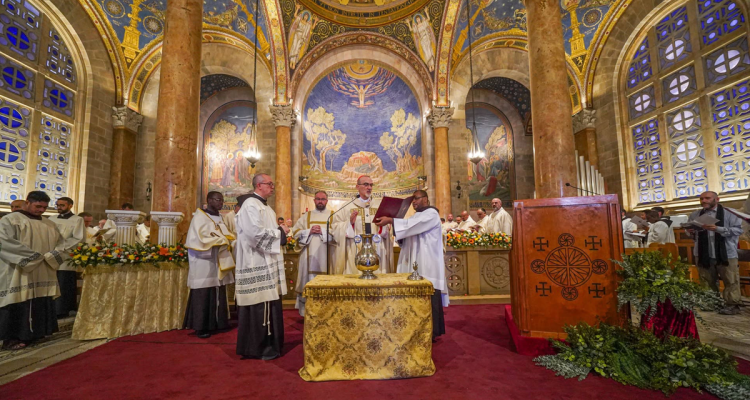
Jerusalem, Gethsemane, June 17, 2026
Is 61:1–3, 6, 8–9; Rev 1:5–8; Lk 4:16–21
Dear brothers and sisters,
Today we celebrate a Chrism Mass that the liturgical calendar places at the heart of Holy Thursday, yet history has brought it to this moment. Still, there is a truth we must recognize with humility and wonder: there is no “delay” for God’s anointing. Instead, there is His kairos, His fullness of time – the moment when the Word ceases to be memory and becomes living flesh. Today, here, in this city that has been a crossroads of peoples and a juncture of passion and resurrection, the Word once again becomes flesh.
The Gospel of Luke presents us with an apparently simple gesture: Jesus enters the synagogue, stands to read, takes the scroll of the prophet Isaiah, and finds the passage where it is written, “The Spirit of the Lord is upon me” (Lk 4:18). This gesture is not merely a ritual. Jesus does not simply interpret ancient Scripture; He fulfills it, makes it present, and turns it into an event.
The anointing of the Spirit that Jesus receives is not a privilege; it is a mission. The mission is clear: to bring good news to the poor, to proclaim freedom to captives, to give sight to the blind, to set the oppressed free.
These are not just fine words. They are a program that overturns all human logic. The poor, the prisoners, the blind, and the oppressed are not abstract categories; they are the faces we have encountered in dark days, the families who have lost everything, the young people whose dreams have collapsed, the elderly who have had to start over. To them, and with them, Jesus turns. We, who today renew our baptismal and priestly anointing, are called to do the same.
The prophet Isaiah, in the first reading, describes the effects of anointing with powerful images: to bind up the brokenhearted, to proclaim freedom, to comfort all who mourn, to give them oil of gladness instead of mourning garments. These words, in biblical tradition, evoke the Jubilee – the holy year in which freedom was restored and hope renewed. But Isaiah is not speaking of a single year; he is speaking of a permanent condition: whoever is anointed by God, becomes an instrument of constant consolation and liberation.
This is the challenge we face today: we are not called to manage suffering, or worse, to suffer it, but to transform it. We are not called to console with empty words, but to generate hope through concrete actions. The oil we consecrate today – the chrism, the oil of catechumens, the oil of the sick – is not a decorative symbol; it is a sign that moves us to action.
The chrism reminds us that we are consecrated to be holy, but holiness is not an escape from the world; it is a courageous immersion in history.
The oil of catechumens reminds us that faith is a journey that unfolds day by day and lasts a lifetime.
The oil of the sick reminds us that God’s anointing accompanies every fragility and sustains us in illness of body and spirit.
This applies not only to us priests, but to the entire People of God. The book of Revelation reminds us of a fundamental truth: Christ has made us a kingdom, priests for His God and Father (Rev 1:6). All the baptized share in this priestly dignity. All are anointed to intercede, to bless, to console. In a land like ours, where divisions seem insurmountable, this awareness becomes an inescapable responsibility. We are called not to live faith as a private matter; faith is the yeast that leavens the dough, the salt that gives flavor, the light that illumines the darkness.
Dear priests, today we renew our promises. We do so as an act of spiritual resilience, resisting resignation, discouragement, and the temptation to abandon the field.
But renewing these promises also means looking ahead. It means asking ourselves: what kind of pastors do we want to be for the future? Pastors who hide behind structures, or pastors who spend themselves among the people? Pastors who speak only to already-Christian communities, or who go out, like Jesus, to seek those who are lost? Pastors who ignore divisions, or who mend what has been torn apart? The anointing we have received is not to divide, but to unite. Not to close, but to open. Not to judge, but to save.
Jesus concludes His address in Nazareth with a clear word: “Today this Scripture has been fulfilled in your hearing” (Lk 4:21). Not tomorrow, not yesterday: today. God’s “today” is not an abstract concept; it is a door that opens in history. What does “today” mean for us? Today, just as he did in the synagogue at Nazareth, the Lord asks us to open the scroll of Scripture again, to read in it the truth of our present, and to texture our lives into it: the life of each of us, the life of our societies, and the life of our Church, with its expectations, hopes, and struggles.
Of course, we are well aware that in our complex context, marked by so many injustices and divisions, it will not be easy to keep this witness alive. But we have a certainty that no historical reality can undermine: God is faithful. His covenant is eternal. His love is stronger than every hatred. And if we have the courage to believe it, then we too can become instruments of His anointing.
From this place, we have a marvelous view over Jerusalem. This city has seen prophets, kings, emperors, crusaders, and pilgrims pass through. This city has been destroyed and rebuilt countless times. This city, which holds the roots of our faith, today once again asks us to choose which side we are on. We want to stand on God’s side, who is always on the side of life and of those who uphold justice and truth.
As we bless the oils, we ask the Lord to bless us as well: to consecrate us, to strengthen us, to heal us. For we need to be healed in order to heal, to be consoled in order to console, to be set free in order to free others. Above all, we need not to lose the memory of who we are: an anointed people, a priestly people, a people called to be a sign of hope in a world that often seems to have lost all hope.
Dear friends,
On this day when we renew our priestly promises, when we renew our “yes” to the Church, allow me to renew once more in prayer the dream of a truly prophetic Church, deeply priestly, authentically royal.
Prophetic, because it is free from human logics of power and therefore capable of consolation, vision, and courage – capable of speaking to the human heart and indicating the answer to the thirst for life and love present in each of us.
Priestly, because it is able to stand between humanity and God, to intercede before God for the good of the world, to bring human life before Him and offer it in love for the world.
Royal, because it is able to witness to Christ’s lordship over the world – a lordship of love, gift, freedom, and gratuitousness.
May the Spirit of the Lord, who today is upon us, accompany us. May He grant us the strength to be, in this city and in this land, living signs of His presence.
Amen.