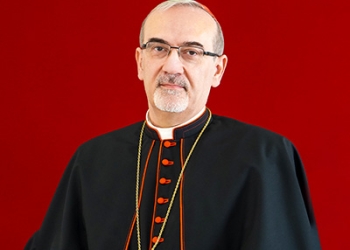
February 10, 2019
Fifth Sunday in Ordinary Time, Year C
At the beginning of this passage (Lk 5:1-11), we see Jesus drawing alongside two boats, on the bank of Lake Tiberias. One of these boats, the one which Jesus gets into, belongs to Peter, and, a little further, in verse 5, we learn that he and his companions worked hard all night, without catching anything.
Jesus therefore approaches and enters the life of this group of men who have just had an experience of intense humiliation, frustration, failure.
At the end of the passage, we still find this same group of men, and this time we also find them empty-handed. But not because they don’t have anything: on the contrary, the passage tells us that in the meantime they caught a great number of fish (Lk 5:6). We find them empty-handed not, however, because their work was fruitless, but because they left everything they fished. So, we find them in a situation that in certain aspects is similar to the beginning, but in others completely different.
What happened to these men?
It seems to me that Peter and his companions have had a fundamental experience, of trusting. They caught nothing, they were going away tired and presumably embittered; and they agree to begin again, to try again not as a result of some new favorable factor, which could have guaranteed them the success of their efforts; they simply trusted the word of this rabbi, teacher (Lk 5:5) who was teaching right there near them, who beside them turned their empty boat into a pulpit from which to teach people.
Peter and his companions have experience that it is worth trusting the master who knows what he says: the new fishing is indeed so fruitful that one boat is insufficient to bring ashore all the fish caught (Lk 5:7).
Peter’s reaction is very important. He recognizes that something exceptional, miraculous, has happened, and so he knows he’s looking at a special person, a prophet, a messenger sent by God; and this is why he distances himself.
He does what any man would do when approaching God: he feels unworthy, he recognizes himself as a sinner, he is afraid, he cannot believe that the Lord is approaching him (Lk 5:8).
But it is precisely here that transformation takes place, because where a man experiences and recognizes his distance from God, his unworthiness, just there He comes.
Jesus overturns the religious logic of separation and distance, which wants two worlds, the sacred and the profane, to remain distinct and distant. He has come precisely to abolish this distance, so that not only does He not turn away from Peter the sinner, but precisely because Peter is a sinner, He approaches him.
And Peter trusts this word, just as before he had trusted the word that invited him to start the task of fishing again. He knows that this trusting is for life and for a full life.
Who has had this experience in his life leaves everything, and becomes an evangelist: has something to announce, something that he first lived, his experience; he can proclaim that God has come near, that He has abolished distances, that He has come to encounter every sinful man.
As Jesus entered Peter’s empty boat to proclaim salvation to all, so Peter and his companions will leave precisely from there to share this proclamation of salvation with men.
Then we can say that Jesus approaches Peter and his companions, and this works a transformation in them: from being failures to being free men. From being persons who daily experience that human strength is not enough to have life, to be persons who have encountered true life, so they can leave everything else, and be with the Lord.
Both, failed people and free men, have empty hands. But the latter have them empty because they have let go of a logic of gain and possession to enter a new viewpoint, that of gratuity and gift.
And we can also say, we’re not sure why, but it seems that the best moment to know the Lord is that of failure, fatigue, humiliation: where our resistance and our arrogance fall, then right there the Lord can approach, and tell us that this closeness is a free gift that reaches us right where we can avail ourselves of mercy.
+ Pierbatistta