July 8, 2018
XIV Sunday of Ordinary Time, year B
Today’s gospel is full of question marks.
We are dealing with five questions, condensed only in two verses. They are questions from a place which is familiar to Jesus, his home town, his “homeland”, presumably Nazareth. Jesus enters in the synagogue. He starts to teach. This arouses first astonishment (Mk 6, 8), later scandal (Mk 6, 3). The questions fluctuate precisely between these two poles: they transform astonishment into scandal or stumbling-block.
If we read attentively the text, we realize that the questions are very specific, and this for two reasons: first of all, these questions do not seek answers; in themselves they already contain a response. Already, they know all. They consist in a list of known data: who is Jesus? Where does he come from? What is his “father’s” profession? Who are his relatives…? As a matter of principle, people do not say wrong things. We are not dealing with questions which go beyond the known data nor which open new horizons. They are questions without anyone to listen to, questions which listen only to themselves. Questions without hope nor wish.
Thus, the questions of the Nazarenes include this unexpected phenomenon, that of Jesus, who irrupted in their lives, in the framework of something already known and consolidated, presuming that nothing new could have ever happened.
The fact of not going beyond the question is a treason for the question itself: man is a being full of question marks, but he is not always capable of going until the end, the depth of things, not always able to take the risk of entering into a reality until then unexplored which could transform his life. He prefers to stay in the “balance” which he had built for himself, a balance which gives him security and does not expose him to the danger of having to change.
The questions of the Nazarenes are specific, not addressed to anyone. Jesus is there, with them, in front of them. He calls them with his word. But they do not enter in dialogue and close themselves before the encounter. They do not address their questions to Him. It would have been something completely different if they had asked Jesus Himself those questions: that would have opened the way to the encounter, and, consequently, to their salvation. Jesus would have saved them from their monologs. Their attitude constitutes a treason: because man was created for the encounter and the dialogue, for the relation. God enters in man’s life through a word, a question, a call which seek a response. If man goes out of this dynamic, he closes himself in himself and betrays himself.
Now, even Jesus in the Gospel, has also questions. We shall tackle only the last one, a dramatic question: on the cross, in the darkest moment of His life, Jesus has only one question: “My God, my God, why did You forsake me?” (Mk 15, 34).He too, like the Nazarenes, finds himself in an unexplainable incomprehensible reality. But Jesus’ strength is the relationship with the Father, a relationship where is room for every question, for every parcel of life: nothing is excluded. Thus, everything gets saved.
As for the inhabitants of Nazareth, on the contrary, they close themselves to salvation because they close themselves in front of the relationship. The gospel says that they were scandalized: they think that that man, Jesus, was a stumbling-block, a danger for their ideas and their certainties. And they reject him.
It is strange that this happens with the closest persons to him, those who knew him best, those who saw him grow: to know Jesus is not the equivalent of knowing his profession or his relatives. To know him is to address Him one’s own questions, especially the deepest and most problematic ones, included those we are reluctant to accept. To know Him is addressing Him our own wish, our own need of salvation, like we saw, last Sunday, in the gospel of the woman suffering from hemorrhage and Jairus’ daughter. We have to ask those questions, like Jesus Himself who addressed to the Father His “unacceptable” question in which one finds all the questions of humankind.
In this road of knowledge, no one may consider himself as beneficiary, with privileges, nor suffering from inconvenience. A disadvantaged person is the one who limits himself to what he already knows, satisfied with what he thinks, not welcoming any challenge which dwells in him, and ignoring his thirst, often painful. It is the person who does not accept to be needy and imperfect.
He closes himself to the encounter, as with the inhabitants of Nazareth, where Jesus “could not make any miracle, but only laid hands on some ill people and healed them. And he was amazed by their lack of faith” (Mk 6, 5- 6).
It was no coincidence that only the ill people opened themselves to the gift of Jesus. This confirms what we said so far. He who has nothing to lose, he who has nothing to which to cling and on which to rely, he can open himself to a gift which renews his life.
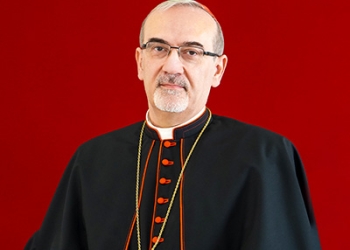
+ Pierbattista